
How the finder works
Choose your citizenship, enter your monthly income before tax (and after tax, if you know it), how you earn it, any savings, and who travels with you. The finder sets your numbers against the published income line of 18 digital nomad and remote work programmes, adds the published amounts for a spouse, partner or children where a country sets them, and sorts every programme into groups: your numbers reach the published line, close to the line, something to check first, below the published line, and not open to your passport. Your answers stay in your browser unless you fill in the free guide form; then a short summary of the result goes with it.
General information, not legal or immigration advice. Each country decides every application, and rules, fees and income lines change. Figures are converted at the reference rates shown, which move. Check the official page linked on each card, or the country's consulate, before you apply.
Each line is converted to your currency at the European Central Bank's euro reference rates for 10 November 2026, Colombia's TRM for the same day, the UAE dirham's peg of 3.6725 to the US dollar and the Panamanian balboa's par with the dollar. Within 10% of a line after conversion, above or below, is shown as close. In the same currency, or between the dollar, the dirham and the balboa, there is no band: 1 under the line is under it.
Which countries have digital nomad visas, and what income do they ask?
These are the 18 programmes in the finder and the income line each one publishes, in its own currency. Mexico has no visa named for digital nomads: the row is the general temporary residence route used by remote workers.
| Country and programme | Published income line | Source |
|---|---|---|
| Spain: telework visa | 2,442 EUR a month before tax (200% of the 1,221 EUR minimum wage), plus 916 EUR for the first family member and 306 EUR for each further one, as the consulate rounds them | BOE, Ley 14/2013 |
| Portugal: remote work visa | 3,680 EUR a month: 4 times the 920 EUR minimum wage, averaged over 3 months; the texts do not say gross or net | Decreto Regulamentar 84/2007 |
| Italy: digital nomad visa | 24,789 EUR a year; the Embassy in Pristina gives 25,500 EUR | Integrazione Migranti |
| Greece: digital nomad visa | 3,500 EUR a month after tax, plus 20% for a spouse or partner and 15% per child | Law 5038/2023 |
| Croatia: digital nomad temporary stay | 3,622.50 EUR a month, plus 144.90 EUR per family member, or 43,470 EUR in savings for 12 months | Ministry of the Interior |
| Malta: Nomad Residence Permit | 42,000 EUR a year before tax | Residency Malta |
| Estonia: digital nomad visa | 4,500 EUR a month; official pages disagree on before or after tax | Embassy of Estonia |
| Hungary: White Card | 3,000 EUR a month after tax, in each of the 6 months before you apply | Immigration and Asylum Office |
| Costa Rica: remote worker stay | 3,000 USD a month, or 4,000 USD in total with family | Ley 10008 |
| Panama: short stay remote worker visa | B/.3,000 a month (B/.36,000 a year), at par with the US dollar | Servicio Nacional de Migración |
| Colombia: digital nomad visa (V) | 5,252,715 COP a month, 3 times the 1,750,905 COP minimum wage, which is provisional | Resolución 5477 of 2022 |
| Mexico: temporary resident visa by economic solvency | More than 79,770.80 MXN a month after tax (680 days of the 117.31 MXN UMA), or an average balance of 1,344,372.60 MXN; plus 220 UMA days per family member | DOF, visa guidelines |
| United Arab Emirates: virtual work residence | 3,500 USD a month | UAE government portal |
| Thailand: Destination Thailand Visa | No income line; funds of 500,000 THB | Thai consulate, Los Angeles |
| Japan: digital nomad status | 10,000,000 JPY a year | Immigration Services Agency |
| Brazil: VITEM XIV | 1,500 USD a month, or 18,000 USD in bank funds | Resolução CNIG 45 |
| Argentina: digital nomad transitory residence | No income line | Disposición DNM 758/2022 |
| Malaysia: DE Rantau Nomad Pass | 60,000 USD a year for Non Tech roles; Tech roles 24,000 USD for applications submitted up to 30 November 2026 and 36,000 USD from 1 December 2026 | MDEC FAQ |
A worked example
A US citizen employed by a company in the United States earns 4,500 USD a month before tax, has 20,000 USD in savings and would travel with a spouse and one child.
- Your numbers reach the published line (8). Brazil, Colombia, Panama, the UAE, Malta, Italy, Costa Rica and Thailand. Costa Rica's family line of 4,000 USD replaces the 3,000 USD line, and 4,500 USD is about 13% above it. The savings are about 34% above Thailand's funds figure of 500,000 THB, about 14,943 USD.
- Close to the line (2). Spain's line for this household is 2,442 + 916 + 306 = 3,664 EUR, about 4,109 USD, so 4,500 USD is about 9.5% above it. Croatia's is 3,912.30 EUR, about 4,387 USD.
- Something to check first (3). Portugal, Hungary and Argentina. Portugal's is 3,680 EUR, about 4,127 USD, for the individual work-income line, but no D8 household total is established. Its general family scale uses the minimum wage net of social security contributions, and the finder does not add guessed euro supplements. Hungary's line is counted after tax and White Card holders cannot bring family; Argentina publishes no income line.
- Below the published line (5). Greece (4,725 EUR after tax with the spouse and child add-ons), Mexico (more than 131,387.20 MXN after tax for three people), Estonia, Japan and Malaysia's Non Tech line.
Are digital nomad visa income requirements gross or net?
It depends on the country, and many do not say. Malta and Spain ask for income before tax. Greece and Hungary count income after tax, and Mexico asks for income free of tax. Estonia's own pages disagree: the e-Residency visa page says after tax, its FAQ says before tax. For those four, add your income after tax: without it, income before tax under the line shows as below (income after tax cannot be higher), and at or above it shows as something to check. Every card says which way its line is counted.
What if I am an EU, EEA or Swiss citizen?
The eight EU programmes (Spain, Portugal, Italy, Greece, Croatia, Malta, Estonia and Hungary) are for citizens of countries outside the EU, the EEA and Switzerland. EU citizens have the right to live and work in any EU country, and the European Commission says citizens of Iceland, Liechtenstein, Norway and Switzerland can work in the EU on the same footing. The finder shows one free movement card instead, quoting each country's rule, and leaves them out of the counts.
Which programmes are not open to my passport?
Japan takes nationals of the 51 countries and regions on its chart, Colombia only passports exempt from its short stay visa, Malaysia excludes citizens of Israel, and Malta does not take applications from a short list of countries. If you hold the country's own citizenship, the visa is not for you. These cards are listed last, and your numbers are not compared.
Why does a programme show something to check first?
A published figure alone may not settle the comparison: tax treatment, conflicting official figures (Italy), an unresolved household requirement (Portugal), family restrictions (Hungary), work type or a programme with no income line can need a check. In Costa Rica, a partner's income can count toward the family line.
Spain's UGE checklist also permits savings or other liquid resources to cover a contract-income shortfall over the entire authorisation. The qualifying remote-work relationship is still required: this is not a savings-only visa. When work income is below the line and savings are entered or left blank, the finder flags the supplement for assessment rather than calculating a pass. Enter zero savings to compare income alone. The card links to the full UGE document.
What the finder does not decide
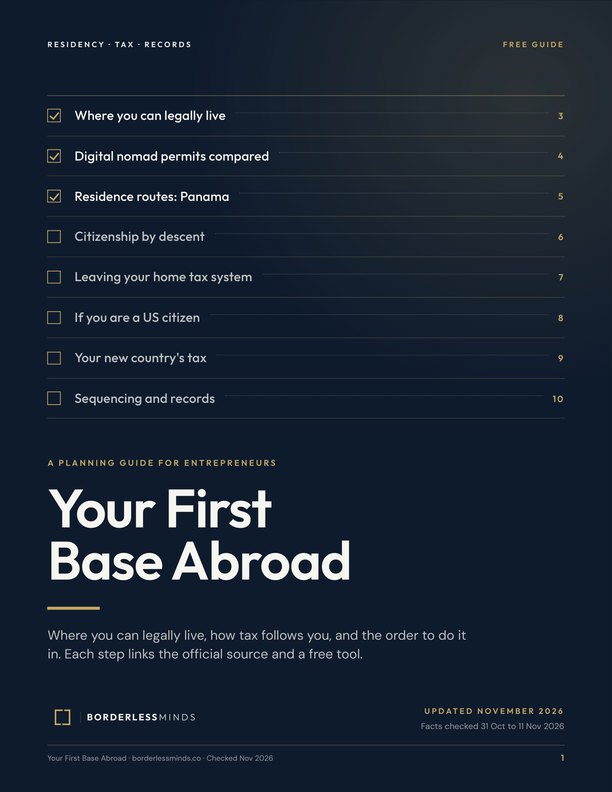
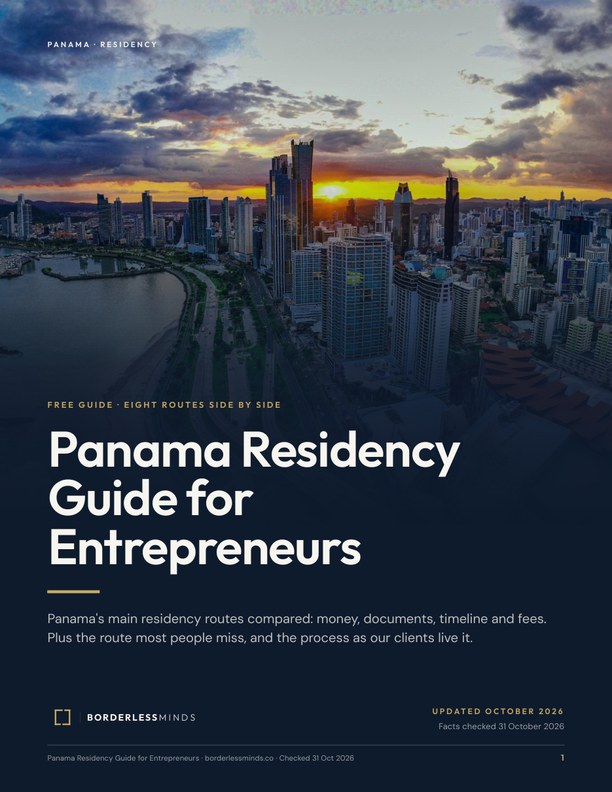
It does not check documents, degrees, work experience or family members' nationality, and it does not cover processing times or tax once you move. If Panama is the base you are weighing, the Panama residency options guide covers the routes beyond the remote worker visa, the which Panama visa tool compares them against your numbers, and the country matching quiz widens the list.
Sources
Every card links to its official sources, checked on 11 November 2026. Exchange rates: ECB euro reference rates for 10 November 2026, Colombia's TRM, the UAE government portal for the dirham peg and the Superintendencia de Bancos de Panamá for the balboa's par. Free movement: Your Europe and the European Commission.